Autumn Children's Books: Cozy Stories for Cold Evenings

- Why autumn stories resonate so deeply with children
- The developmental value of reading together in autumn
- The richest autumn themes for children's books
- Animals and hibernation
- Wind, rain, and falling leaves
- Light in the darkness
- Harvest, sharing, and gratitude
- Choosing the right autumn book by age
- Babies and toddlers (0-2 years)
- Preschoolers (3-5 years)
- Early readers (6-8 years)
- Building a cozy autumn reading ritual
- Even more special: a book with your child as the hero
- Turning cold evenings into your favourite moments
The clocks have gone back, rain is tapping against the window, and the first candles are flickering on the table again. Where summer evenings once stretched on forever, autumn quietly pulls everyone closer together. That is exactly what makes this season so perfect for an old ritual that never goes out of style: reading a story together under a warm blanket.
A good autumn book is more than a way to pass the early darkness. It helps children make sense of big themes like change, letting go, comfort, and the patience of waiting for what comes next. In this article you will discover why seasonal stories are so valuable, which themes suit autumn best, and how to get the most out of your reading evenings at every age.
Why autumn stories resonate so deeply with children
Children understand the world best through familiar images, and autumn hands those images over for free. Think of swirling leaves, hedgehogs curling into a ball, conkers rattling in a coat pocket, and squirrels stashing acorns before winter. When a child meets one of these images in a book and then spots it outdoors for real, a powerful connection forms between story and reality.
Developmental psychologist Jean Piaget described how young children learn by linking concrete experiences to mental ideas. A seasonal story does precisely this: it puts language to what your child sees and feels. The child learns that it is normal for it to grow dark earlier, that cold weather belongs to this time of year, and that after autumn a new season always follows.
Autumn stories also tend to touch on themes that run deeper than the weather:
- Change and letting go: Trees shedding their leaves offer a gentle image for talking about goodbyes, whether that means the end of summer, a holiday that is over, or routines that are shifting.
- Comfort and safety: Stories about animals seeking out a warm burrow give children the reassuring feeling that home is a safe harbour when the weather turns wild.
- Patience and looking ahead: The squirrel hiding nuts and the seed waiting quietly underground teach children that not everything has to happen at once, and that waiting can lead to something wonderful.
The developmental value of reading together in autumn
Reading aloud is one of the most well-researched activities in child development. Studies show again and again that children who are read to regularly build a larger vocabulary, concentrate more easily, and learn to read at school with less struggle. The dark evenings of autumn make it almost effortless to give this ritual a permanent place in your day.
Alongside language development, something emotionally important happens too. When your child snuggles against you and you both look at the same page, you create what psychologists call "joint attention." You experience the same moment, share the same feeling at a scary or funny passage, and feel genuinely connected. That sense of safety is the foundation on which children dare to grow.
Autumn stories also open a natural door to talking about feelings. A story about a hedgehog who is nervous about the first cold night lets you ask, "Do you ever feel a bit scared in the dark too?" This is how children learn that feelings are allowed and that you can talk about them. If you would like more inspiration for reading rituals throughout the year, you will find plenty on our blog.
The richest autumn themes for children's books
Not every autumn book covers the same ground. By deliberately choosing a theme that matches your child's age and inner world, the story becomes even more meaningful. Here are the most rewarding autumn themes, each with an idea to deepen the conversation.
Animals and hibernation
Hedgehogs, bears, squirrels, and dormice make wonderful main characters. Stories about animals gathering supplies or building a warm nest appeal strongly to children because they easily see themselves in small, vulnerable creatures. After reading, ask: "What would you collect if you were a squirrel?" That single question turns listening into a real conversation.
Wind, rain, and falling leaves
Autumn is the season of movement: branches whipping about, puddles begging to be jumped in, leaves tumbling everywhere. Books full of sound and rhythm, the kind you can hum along to or act out, work brilliantly here. Follow the story with a short walk together, hunting for the most colourful leaves you can find.
Light in the darkness
As the evenings grow shorter, the longing for warmth and light grows too. Many cultures mark this time with cosy indoor gatherings, glowing lanterns, and candlelit celebrations, and in North America the pumpkins and jack-o'-lanterns of Halloween carry that same spirit of light against the dark. Stories about a small light showing the way fit this atmosphere beautifully.
Harvest, sharing, and gratitude
Autumn is harvest time. Pumpkins, apples, nuts, and the last vegetables from the garden lend themselves to stories about caring for one another, sharing, and appreciating what you have. This theme sits perfectly alongside a Thanksgiving story and helps children develop gratitude, a trait that positive psychology links strongly to lifelong happiness.
Choosing the right autumn book by age
A book that enchants a toddler will bore a six-year-old to tears. To make your reading evening a success, it helps to match the book to your child's stage of development. Here is a practical guide.
Babies and toddlers (0-2 years)
Choose sturdy board books with large, high-contrast pictures of autumn elements such as a leaf, an apple, or a hedgehog. At this age it is all about recognising and naming, not following a plot. Keep it short: five to ten pages is plenty, because toddlers have a brief attention span and genuinely love repetition. Feel free to read the same little book ten evenings in a row. Involve the senses too, with touch-and-feel books that have a rough hedgehog back or a soft leaf, pointing together and making playful sounds.
Preschoolers (3-5 years)
Introduce a simple story with a beginning, middle, and end. Preschoolers can now follow a small problem, such as an animal that needs to build its winter nest before the cold arrives. Lean into emotions, because at this age children are learning to name feelings: pick stories where a character is scared, happy, or proud, and talk about it together. Make it interactive by asking predictive questions like "What do you think will happen next?" This trains the listening comprehension that later supports learning to read. You will find more ideas on our page full of book inspiration.
Early readers (6-8 years)
Offer longer stories with chapters, or richer picture books with more text. Children this age love a story that unfolds over several evenings, which is a lovely way to practise anticipation and patience. Let your child read along, taking turns with a sentence or a page, and choose autumn words that are challenging but achievable so reading stays fun rather than frustrating. Books that explore the cycle of nature, or friendship and teamwork, suit their growing ability to think in more abstract ways. To search for books that fit your child's age, take a look at our overview of inspiration by age.
Building a cozy autumn reading ritual
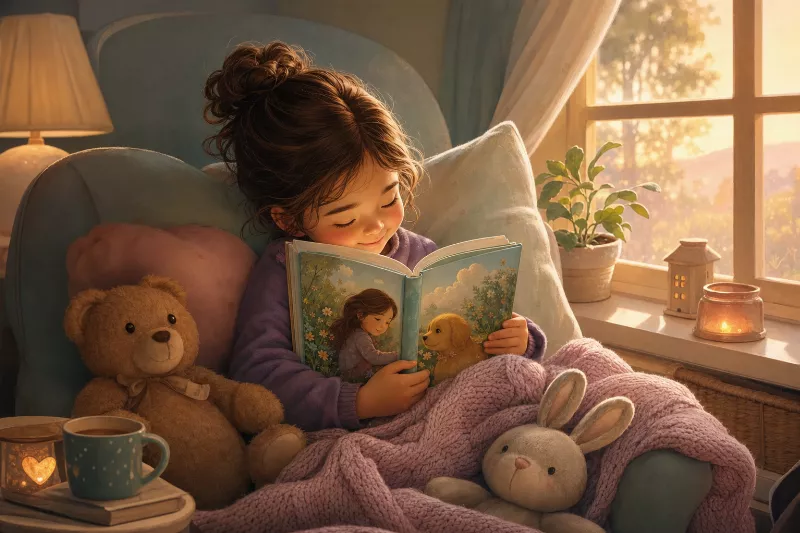
The magic of reading aloud lies not only in the book but in the ritual around it. Children thrive on predictability, and a fixed reading moment gives the day a gentle anchor and lets the evening wind down calmly. Here is how to build an autumn ritual that sticks, step by step:
- Choose a set time and place. For example, every evening after brushing teeth, in the same corner of the sofa under the same blanket. Repetition makes the moment familiar and reassuring.
- Create the atmosphere. Turn off the big light, light a (battery) candle, or use a soft reading lamp. A mug of warm cocoa completes the scene. These sensory details make the moment feel magical and help your child settle.
- Let your child help choose. Offer a choice of two or three books. Getting to decide for themselves hugely increases engagement and the sheer joy of reading.
- Take time to talk. Do not close the book the instant it ends. Ask what your child found most exciting or funniest. This helps them process the story and deepens your bond.
- Be enthusiastic yourself. Children can tell instantly whether you are enjoying it. Play with voices, pause at the tense moments, and let them see that you love it too.
Even more special: a book with your child as the hero
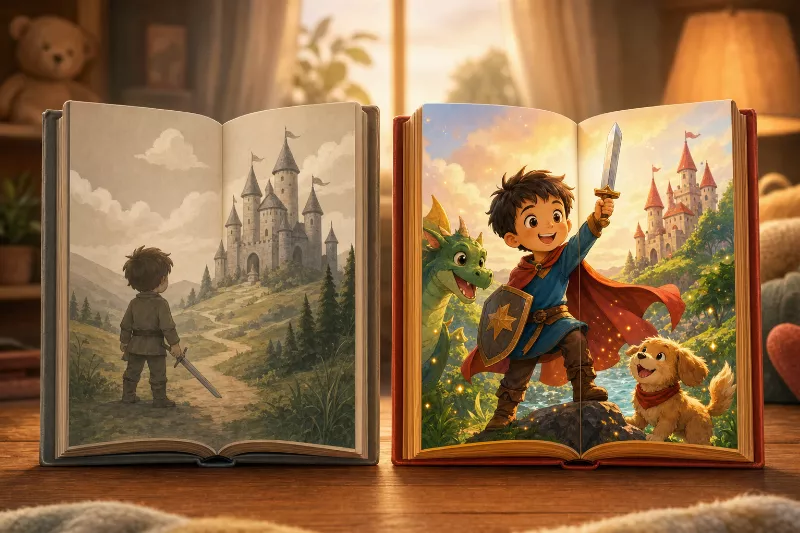
What makes an autumn story truly unforgettable is when your child appears in it. Research into reading motivation shows that children listen longer and more attentively when a story is personally relevant to them. Hearing their own name, or seeing themselves as the brave hero walking through the autumn woods, gives a story an extra layer of magic.
A personalized book combines the warmth of a seasonal story with that thrilling feeling of "this is really about me." Your child becomes the main character who helps the squirrel or carries the last light through the dark evening. For children who are just discovering that they are unique and valuable, that is a small but powerful gift of confidence.
Curious what this looks like? Take a look at a few examples of personalized books, or create something special yourself on the page to make your own book. As a gift for an autumn birthday or the approaching winter holidays, it becomes a keepsake that lasts far longer than the season itself.
Turning cold evenings into your favourite moments
Autumn invites us to slow down. The early darkness is not a setback but an invitation to huddle up, share a blanket, and open a story. Whether you reach for a tale about a hedgehog building its nest, a light glowing in the dark, or a book with your own child as the hero, what matters most is that feeling of closeness.
Pick a book that suits your child's age, build a small ritual, and enjoy the calm these evenings bring. Before you know it, these are the memories your child will look back on with warmth for years to come.
Last updated on
16-08-2026
Table of Contents
- Why autumn stories resonate so deeply with children
- The developmental value of reading together in autumn
- The richest autumn themes for children's books
- Animals and hibernation
- Wind, rain, and falling leaves
- Light in the darkness
- Harvest, sharing, and gratitude
- Choosing the right autumn book by age
- Babies and toddlers (0-2 years)
- Preschoolers (3-5 years)
- Early readers (6-8 years)
- Building a cozy autumn reading ritual
- Even more special: a book with your child as the hero
- Turning cold evenings into your favourite moments